Get the Latest in Your Inbox
Want to stay up to date on the state of the world’s forests? Subscribe to our mailing list.
Subscribe
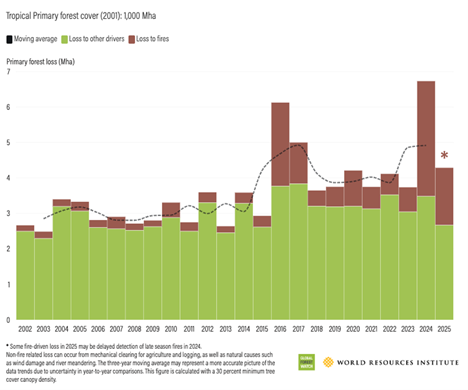
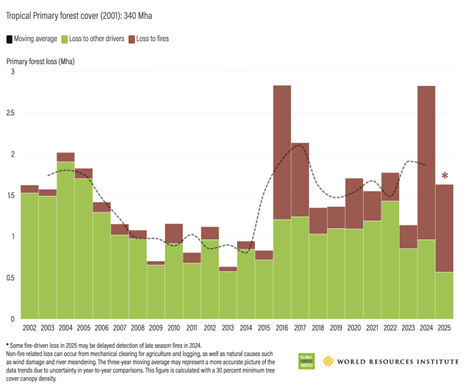
Primary forest loss in the tropics eased in 2025, following record-shattering losses in 2024 driven by extreme fires. New data from the University of Maryland’s GLAD lab, available on WRI’s Global Forest Watch and Global Nature Watch, shows that loss of tropical primary rainforests fell by 36% compared to 2024.
Tropical primary forest loss decreased by 36% from 2024 to 2025 following a record-breaking year of extreme fires
Less
This year the tree cover loss data is also available on Global Nature Watch, an open, AI-powered platform developed by WRI that brings together peer-reviewed research from Global Forest Watch and Land & Carbon Lab in a simple, chat-style interface that makes complex land data easy to use. Next year, Global Nature Watch will be where users go to explore the tree cover loss data and the suite of WRI's data-driven forest and land research. Explore Global Nature Watch here.
Less
While the reduction is encouraging, the world still lost 4.3 million hectares of tropical primary forest in 2025, equivalent to more than 11 football (soccer) fields of forest per minute. Tropical primary forest loss is still 46% higher than a decade ago.
This continued forest loss undercuts the many services tropical primary forests provide. These ecosystems are critical for biodiversity, water provision, carbon storage, food and medicines, cultural identity and more.
More
Why do we focus on tropical primary forests? Though the tree cover loss data from the University of Maryland has global coverage, Global Forest Watch primarily focuses on loss in the tropics because that is where 94% of deforestation, or human-caused, long-term removal of forest, occurs. This piece largely focuses on primary forests in the humid tropics, which are areas of mature rainforest that are especially important for biodiversity, carbon storage and regulating regional and local climate.
More
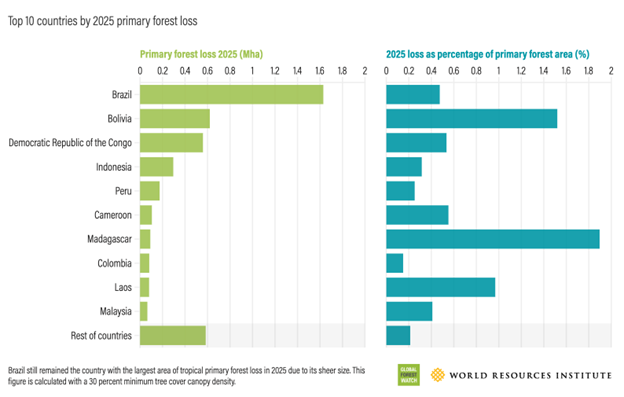
Much of the reduction in 2025 came from sharp declines in Brazil, which experienced a 42% reduction in primary forest loss. However, Brazil still ranked as the country with the largest area of tropical rainforest loss, given the sheer size of its forests.
Several other major forested countries, including Colombia, Indonesia and Malaysia, also saw relatively low or stable rates of forest loss in 2025 compared to recent years. Tropical primary forest loss remained high in countries such as Bolivia and the Democratic Republic of the Congo.
A few countries dominated tropical primary forest loss in 2025 by area, but the breakdown is different by percentage
More
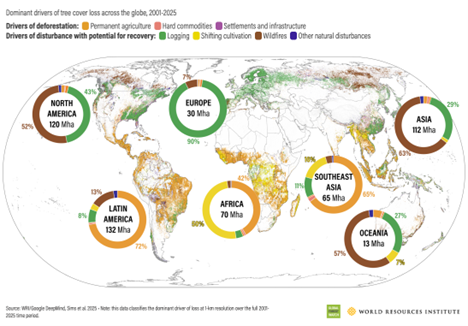
Agricultural expansion was the leading cause of tree cover loss across the tropics, including both market-oriented commodity production and subsistence farming to meet household needs. Globally, fires were again a major driver of tree cover loss in 2025, consistent with recent trends. For the past three years, fires burned more than twice as much tree cover as they did two decades ago. Climate change is threatening forests both inside and outside the tropics, with extreme heat and drought fueling bigger, more damaging forest fires.
2025 continued trends seen over the last 25 years, with agriculture leading tropical tree cover loss and fires driving loss in northern temperate and boreal regions
More
To better understand underlying trends in forest loss, it is useful to consider non-fire loss separately from fire-related loss. Fire has become an increasingly prominent driver of forest loss globally, in part due to feedback loops from climate change, but it is also highly variable from year to year depending on weather conditions such as drought.
Some of the fire-related loss that shows up in the 2025 data actually occurred during late-season fires in 2024 that were not captured earlier due to smoke and haze, which can delay satellite detection. This lag in detection makes it challenging to assess how much loss from fire occurred in 2025 and how fire-driven loss changed from 2024 to 2025, particularly after such an extreme fire year in 2024. Fires can cause significant damage, and forests do not always recover.
By contrast, non-fire related loss such as clearing for agriculture, infrastructure, logging or mining is less influenced by short-term variability in weather and detection.
Read More +
More
With only a few years remaining to meet the global goal of halting and reversing forest loss by 2030, countries like Brazil show that protecting forests is possible through policies and other measures. But achieving the global goal won’t be easy as forests become more vulnerable to climate change and humanity’s growing demand for food, fuel and materials sourced from forests and the lands they stand on.
Here is a deeper look at some of the key findings from the 2025 data:
More
Policy Is Slowing Forest Loss in Key Tropical Countries
Several countries reduced or at least stabilized their forest loss in 2025, including Brazil, Colombia, Indonesia and Malaysia. These encouraging developments were associated with changes in policy, improved law enforcement and voluntary corporate actions to limit forest clearing. It’s clear that when countries have the political resolve to improve forest governance, they can reduce forest loss relatively quickly.
Brazil provides one of the clearest examples. Home to the largest rainforest in the world, Brazil experienced the lowest rate of non-fire primary forest loss on record in 2025, 41% lower than in 2024. Brazil also had a lower percentage of loss than many other countries, losing 0.5% of its primary forest in 2025. These findings align with PRODES, Brazil’s official forest monitoring system.
Brazil substantially reduced primary forest loss in 2025 and saw its lowest level of non-fire primary forest loss on record
More
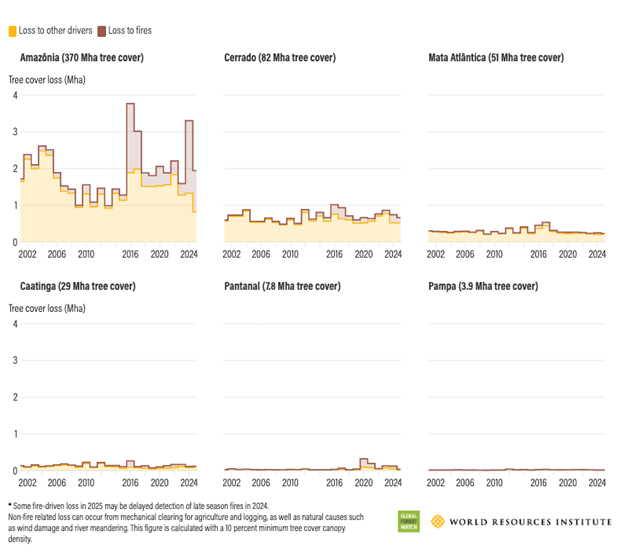
Outside of primary rainforests, most other Brazilian biomes also saw reduced tree cover loss, except the Caatinga, which increased by 9%. Amazonia and the Pantanal had the largest reductions of tree cover loss from 2024 to 2025.
Tree cover loss declined in most Brazil biomes from 2024 to 2025
More
Brazil’s declines are associated with stronger environmental policies and enforcement since 2023, when President Luiz Inácio Lula da Silva (known as Lula) came into office. For example, the Lula administration relaunched the PPCDAm, an anti-deforestation policy framework that coordinates actions across 19 federal agencies, and expanded it to cover all biomes. Originally established in 2004, the PPCDAm helped drive major declines in primary forest loss in the Amazon in the early 2000s. Law enforcement has also increased — Brazil’s federal environmental agency, IBAMA, increased environmental violation notices by 81% and fines by 63% from 2023-2025 compared to 2020-2022.
Brazil has also played an important role in shaping global efforts to protect forests, including launching the Tropical Forest Forever Facility at COP30, a proposed financial mechanism to reward tropical forest countries for preserving their forests.
However, threats to Brazil's forests remain. Permanent agriculture continues to be the largest driver of primary forest loss (73% between 2002-2025), largely for soy and cattle. Some states in the Amazon have passed legislation to weaken environmental protections at the state level, threatening to undermine progress.
For example, Rondônia, Maranhão and Mato Grosso removed tax incentives for companies that are part of the soy moratorium, a voluntary agreement among soy traders to not buy soy from deforested areas in the Amazon. These moves increase uncertainty around the future of the soy moratorium, and is one reason why in early 2026 major soy traders announced plans to withdraw from the agreement.
Additionally, while government actions to reduce fires and improved weather conditions slowed fire-driven loss in Brazil overall, there were still hotspots of fires in the state of Maranhão that were likely human-set.
Other tropical countries that saw a decline or stabilization in forest loss include:
Colombia
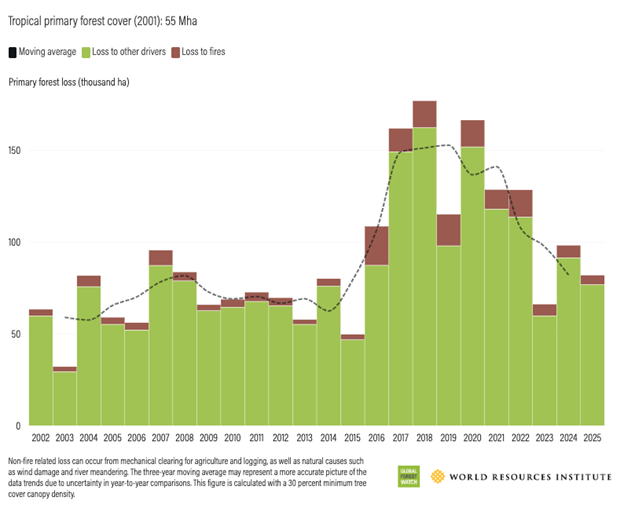
Primary forest loss in Colombia declined by 17% from 2024 to 2025. This was the second-lowest year since 2016, but higher than the low level in 2023.
Colombia primary forest loss declined by 17% from 2024 to 2025
More
The decline is linked to government policies and agreements aimed at limiting forest clearing. For example, a 2025 resolution established the legal framework to create forest concessions for rural community members as a tool for forest conservation. The recent recognition of Indigenous Territorial Entities to self-govern swaths of the Colombian Amazon is also a major step forward, giving Indigenous Peoples more authority to defend their forests. A new law mandating traceability for the country’s cattle sector is also a significant development, aiming to ensure that beef sold in Colombian markets is not linked to deforestation.
Still, threats continue. Roads have been expanding into the Amazon’s forests, including within protected areas and Indigenous Territories. These presumably illegal roads are often linked to activities involving armed groups, including illicit crop production, land grabbing and the subsequent expansion of cattle ranching. And despite the country’s recent ban on new mining projects in the Amazon, illegal mining is an emerging threat.
Indonesia
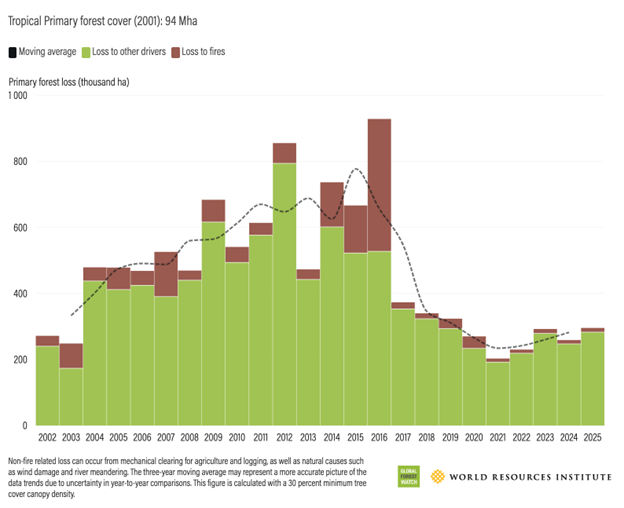
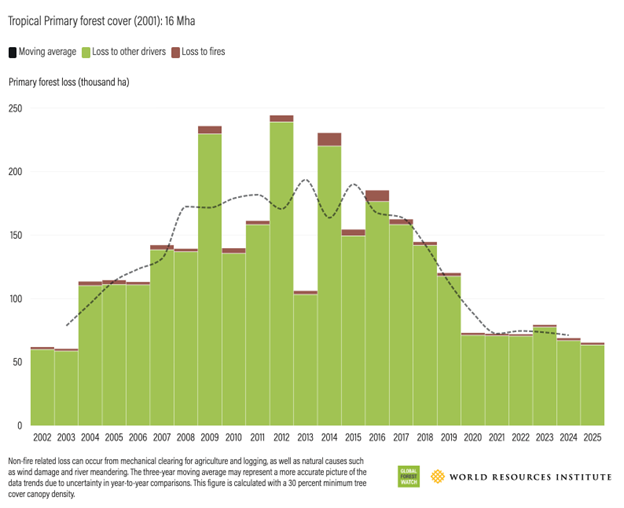
Primary forest loss increased by 14% in Indonesia from 2024 to 2025, but rates remained well below the highs of the mid-2010s. (Read more here about how the UMD data differs from Indonesia’s official data.)
Indonesia primary forest loss increased by 14% from 2024 to 2025, driven in part by agricultural expansion and mining activities
More
Government policies have helped keep forest loss relatively low in recent years, including a permanent moratorium on new permits in primary forests and peatlands, strengthened fire prevention and monitoring and Indonesia’s FOLU Net Sink 2030 target, which aims for the forestry and land use sector to absorb more carbon than it emits by the end of the decade. Voluntary private sector commitments to deforestation-free pulp and palm oil production have also played a role. Newer pledges to strengthen Indigenous Peoples’ land rights also signal continued momentum on forest protection.
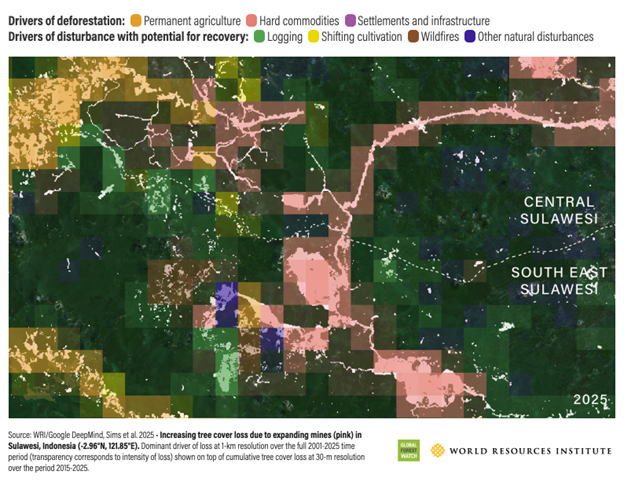
Some of the 2025 uptick is linked to agricultural expansion, including forest clearing in South Papua associated with the government’s food estate program. This policy is part of a larger push to increase food and energy security and is expected to continue shaping land use in the coming years. Mining expansion, particularly for nickel, is also fueling forest loss in Sulawesi and other regions.
Mining expansion fueled forest loss in Sulawesi, Indonesia
More
Malaysia
Malaysia is another example where policies are working to stabilize forest loss. Oil palm expansion has historically driven most forest clearing in Malaysia — policies targeting the sector have had an outsized impact on reducing forest loss. Government efforts to limit the expansion of oil palm into forest areas, strengthen forest governance and commit to maintaining at least 50% forest cover are working alongside voluntary corporate commitments to reduce deforestation. More recently, a stronger Malaysia Sustainable Palm Oil (MSPO) certification likely helped sustain lower rates of forest loss as well.
Malaysia primary forest loss remained low in 2025
More
However, Malaysia has lost nearly a fifth of its primary rainforests since 2001, largely due to agricultural expansion and logging.
More
Commodity Expansion Drove Forest Loss in Latin America and Southeast Asia
Demand for commodities such as cattle, soy, palm oil, gold and other minerals continued to fuel forest loss in some countries, particularly in parts of Latin America and Southeast Asia. While the drivers of forest loss vary by country, they reflect a common challenge of persistent economic incentives to convert forests while undervaluing the many benefits they provide.
Bolivia
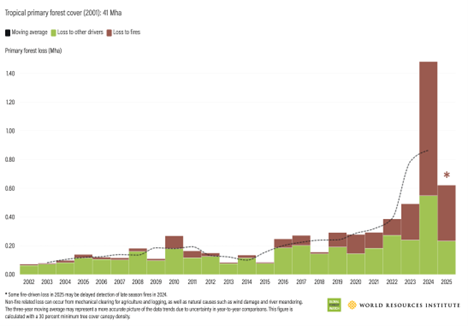
Primary forest loss reached its second-highest level on record in Bolivia in 2025, following last year’s record-breaking fires. Bolivia once again had the second-highest amount of tropical primary forest loss in 2025, higher than the Democratic Republic of the Congo, despite containing 60% less primary forest area.
Bolivia primary forest loss in 2025 was the second highest on record, after an unprecedented increase in 2024
More
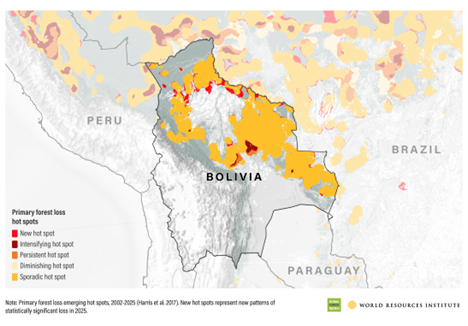
Fires, likely set by humans, drove much of the primary forest loss in 2025, though much of this loss includes delayed detection of late-season fires from 2024, when Bolivia experienced a devastating fire year following severe droughts. Even though rainfall returned to normal levels in some parts of the country in 2025, Bolivia will need to take proactive measures on fire prevention and mitigation to avoid catastrophic fires in the future, especially as climate change increases the frequency and intensity of dry, hot conditions.
New hot spots of primary forest loss in Bolivia show continued expansion of forest loss in the north, capturing large scale fires in El Beni
More
Non-fire primary forest loss was fourth highest on record, largely caused by expansion of cattle ranching and crops such as soy, maize and sorghum. Losses continued despite 2025 fuel shortages that limited the use of agricultural machinery and disrupted transportation across supply chains. There are few indications that Bolivia is likely to take action to prevent further agricultural encroachment into the country’s forests.
Peru and Laos
While Peru and Laos saw declines in primary forest loss from 2024 to 2025 (8% and 31%, respectively), both countries remained in the top 10 list for highest area of tropical primary forest loss. Overall rates of forest loss were elevated in 2025 compared to earlier years due to agricultural expansion.
In Peru, loss was driven largely by expansion of crops such as cocoa and oil palm, as well as mining. For example, gold mining was responsible for 33% of primary forest loss from 2002-2025 in the Madre de Dios region.
In Laos, loss was driven especially by rubber, cassava, bananas and other agricultural exports linked to markets in China, Thailand and Vietnam. Small-scale subsistence farming also caused forest loss in some areas.
More
Subsistence Needs and Governance Challenges Fueled Forest Loss in Some Regions
While large-scale commodity production drives forest loss in some regions, in others, including parts of the Congo Basin, Madagascar and parts of Southeast Asia such as the highlands in Myanmar and northern Laos, loss is more closely linked to local needs for food and fuelwood, stemming from poverty and limited economic alternatives. Population growth, unstable governance and economic conditions also contribute.
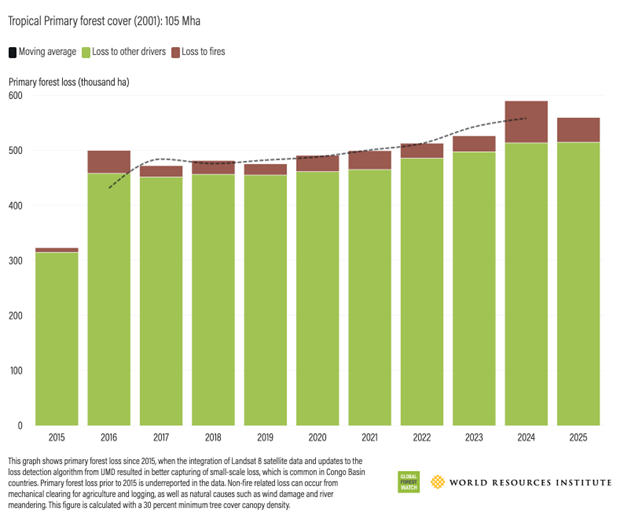
For example, the Congo Basin, which includes Cameroon, the Central African Republic, the Democratic Republic of the Congo, Equatorial Guinea, Gabon and the Republic of Congo, is the world’s largest remaining tropical forest carbon sink and plays a critical role in regulating the global climate. But in some Congo Basin countries, loss of primary forest has been increasing over the past decade.
The Democratic Republic of the Congo (DRC), which holds the world's second-largest area of tropical primary forest, experienced the third-highest amount of tropical primary forest loss in 2025. However, its percentage of loss (0.5%) remained lower than many countries.
DRC primary forest loss declined by 5% from 2024 to 2025, but non-fire loss was the highest on record
More
Most of DRC’s primary forest loss (86% between 2002 and 2025) was due to small-scale shifting cultivation, where land is cleared for short-term crop cultivation and then left fallow for forests and soil nutrients to recover. Wood harvesting for firewood and charcoal, the dominant form of energy in the country, was also a major driver. Non-fire-related primary forest loss was the highest on record for the country, suggesting that these drivers continue to intensify.
In eastern DRC, ongoing conflict has forced communities into new areas, where many cleared forests to make new settlements, farms or to gather wood for housing and fuel. Mining was also a contributor, which provides livelihoods and, in some areas, operates under the control of armed groups. Mining can also indirectly drive forest loss by bringing more people into previously remote regions, who then clear forests for agriculture and settlements.
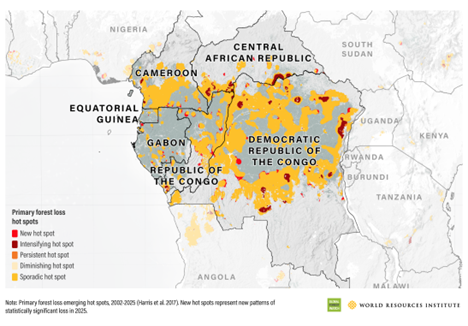
New hot spots of primary forest loss in DRC are near areas of conflict in the east, and areas of new shifting cultivation in the west
More
Permanent conversion of forests to produce agricultural commodities for export remained a smaller but growing threat to DRC’s forests. For example, the country’s cocoa production area increased more than five-fold from 2015-2024.
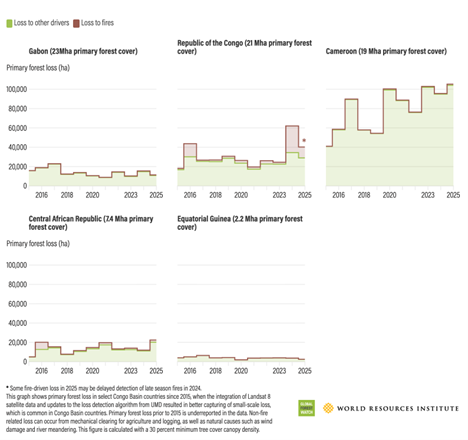
Forest loss varied across other Congo Basin countries.
Congo Basin primary forest loss in 2025 varied across countries
More
The Republic of Congo and Gabon, both “High Forest Low Deforestation” countries, experienced low levels of loss in 2025 after a surge in fire-related loss in 2024 in the Republic of Congo. Cameroon, however, experienced its highest primary forest loss on record. Cameroon is the third-largest cocoa producer in Africa and increases in primary forest loss in recent years were partially due to cocoa production, as well as communities displaced by armed conflict.
Continued primary forest loss in the Congo Basin, including in its vast ancient peatlands which store large amounts of carbon, can weaken the region’s ability to store carbon and regulate the climate. It also threatens the livelihoods and food security of the roughly 100 million people who depend on these forests, the very communities whose needs are driving much of the loss.
More
Climate Change Is Increasing Threats to Forests Worldwide
Climate change is a large and growing force behind forest loss. It intensifies drought, heat and storms that make forests more vulnerable to fire, wind, pests and disease.
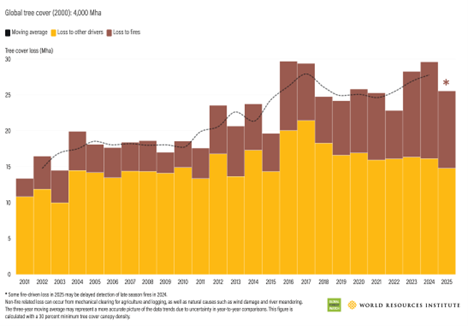
While all forests face growing fire risks, wildfires had the most visible impacts in boreal and temperate regions in 2025. Fires were responsible for 42% of the 25.5 million hectares of tree cover loss globally in 2025, an area larger than the size of the United Kingdom.
Global tree cover loss declined by 14% in 2025, but fires drove increasing proportions of loss in recent years
More
While some amount of fire is normal for boreal and temperate ecosystems, climate change is worsening fire seasons. Loss due to fire was especially evident in North America and Europe, where hot and dry conditions contributed to particularly severe wildfire seasons.
North America
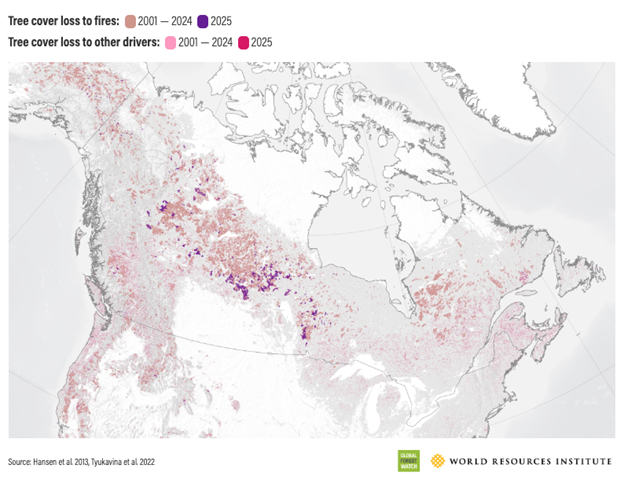
Wildfires burned through northern boreal forests in Canada and Alaska, as well as parts of the Rocky Mountains. Wildfires caused 5.3 million hectares of tree cover loss in Canada, forcing the evacuation of more than 80,000 people and spewing smoke into highly populated parts of the United States and Canada.
Fires drove much of the tree cover loss in Canada in 2025
More
Accelerating Action Is Essential to Halting Forest Loss by 2030
The 2025 data shows that reductions in forest loss are possible. Big declines in Brazil along with relatively low or stable rates of forest loss in Colombia, Indonesia and Malaysia highlight how policy choices, law enforcement and corporate commitments can improve forest outcomes. At the same time, high forest loss in other regions underscores the need for sustained and expanded efforts to prevent forest loss.
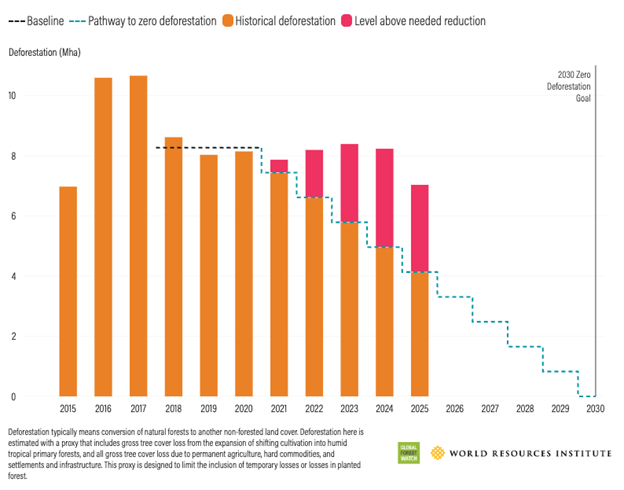
With only a few years remaining to meet the global goal of halting and reversing forest loss by 2030, countries will need to accelerate action.
Deforestation in 2025 was 70% higher than the level needed to halt and reverse forest loss by 2030
More
Failing to achieve this global goal will have far-reaching consequences. High or increasing levels of forest loss push critical ecosystems closer to tipping points — thresholds beyond which forests may not recover. In forests like the Amazon, deforestation and climate change could shift parts of the rainforest toward a degraded, savannah-like state. Losing forests means the world loses its best partner in protecting biodiversity, halting climate change, sustaining rainfall, protecting livelihoods and cultural identity and more.
Several developing stories will likely have a large influence on future forest loss trends. Expected El Niño conditions in 2026 will test whether countries are better prepared to prevent and respond to large-scale fires. At the same time, policy and financial developments will likely shape the trajectory of forest loss — including whether the Tropical Forest Forever Facility secures the investment needed and how effectively global regulations such as the EU Deforestation Regulation (EUDR) are implemented and enforced.
Decisions at national levels will also shape forest outcomes. For example, in Brazil and Colombia, upcoming elections will play key roles in determining whether recent declines in forest loss can be sustained. In Indonesia, efforts to expand food and energy production through the food estate program will test whether development goals can be achieved without further forest clearing.
These developments will shape the future of forest loss — and thus, the future of people and the planet.
Explore the data yourself on Global Forest Watch
More
{"Glossary":{"141":{"name":"agroforestry","description":"A diversified set of agricultural or agropastoral production systems that integrate trees in the agricultural landscape.\r\n"},"101":{"name":"albedo","description":"The ability of surfaces to reflect sunlight.\u0026nbsp;Light-colored surfaces return a large part of the sunrays back to the atmosphere (high albedo). Dark surfaces absorb the rays from the sun (low albedo).\r\n"},"94":{"name":"biodiversity intactness","description":"The proportion and abundance of a location\u0027s original forest community (number of species and individuals) that remain.\u0026nbsp;\r\n"},"95":{"name":"biodiversity significance","description":"The importance of an area for the persistence of forest-dependent species based on range rarity.\r\n"},"142":{"name":"boundary plantings","description":"Trees planted along boundaries or property lines to mark them well.\r\n"},"98":{"name":"carbon dioxide equivalent (CO2e)","description":"Carbon dioxide equivalent (CO2e) is a measure used to aggregate emissions from various greenhouse gases (GHGs) on the basis of their 100-year global warming potentials by equating non-CO2 GHGs to the equivalent amount of CO2.\r\n"},"153":{"name":"climate domain","description":"Major ecosystem regions, summarized as boreal, temperate, tropical and subtropical.\u0026nbsp;"},"99":{"name":"CO2e","description":"Carbon dioxide equivalent (CO2e) is a measure used to aggregate emissions from various greenhouse gases (GHGs) on the basis of their 100-year global warming potentials by equating non-CO2 GHGs to the equivalent amount of CO2.\r\n"},"1":{"name":"deforestation","description":"The change from forest to another land cover or land use, such as forest to plantation or forest to urban area.\r\n"},"77":{"name":"deforested","description":"The change from forest to another land cover or land use, such as forest to plantation or forest to urban area.\r\n"},"76":{"name":"degradation","description":"The reduction in a forest\u2019s ability to perform ecosystem services, such as carbon storage and water regulation, due to natural and anthropogenic changes.\r\n"},"75":{"name":"degraded","description":"The reduction in a forest\u2019s ability to perform ecosystem services, such as carbon storage and water regulation, due to natural and anthropogenic changes.\r\n"},"79":{"name":"disturbances","description":"A discrete event that changes the structure of a forest ecosystem.\r\n"},"68":{"name":"disturbed","description":"A discrete event that changes the structure of a forest ecosystem.\r\n"},"65":{"name":"driver of tree cover loss","description":"The cause of tree cover loss, such as agriculture or urban development. There are direct drivers, which are the immediate cause of the loss, and indirect drivers, which are the secondary cause of loss (i.e., land speculation)."},"70":{"name":"drivers of loss","description":"The cause of tree cover loss, such as agriculture or urban development. There are direct drivers, which are the immediate cause of the loss, and indirect drivers, which are the secondary cause of loss (i.e., land speculation)."},"81":{"name":"drivers of tree cover loss","description":"The cause of tree cover loss, such as agriculture or urban development. There are direct drivers, which are the immediate cause of the loss, and indirect drivers, which are the secondary cause of loss (i.e., land speculation)."},"102":{"name":"evapotranspiration","description":"When solar energy hitting a forest converts liquid water into water vapor (carrying energy as latent heat) through evaporation and transpiration.\r\n"},"154":{"name":"fastwood monoculture","description":"Stands of single species planted trees that grow quickly.\u0026nbsp;"},"53":{"name":"forest degradation","description":"The reduction in a forest\u2019s quality and ability to perform ecosystem services, such as carbon storage and water regulation, due to natural and anthropogenic changes."},"54":{"name":"forest disturbance","description":"A discrete event that changes the structure of a forest ecosystem.\r\n"},"100":{"name":"forest disturbances","description":"A discrete event that changes the structure of a forest ecosystem.\r\n"},"5":{"name":"forest fragmentation","description":"The breaking of large, contiguous forests into smaller pieces, with other land cover types interspersed.\r\n"},"155":{"name":"Forest Landscape Restoration","description":"The ongoing process of restoring landscapes to regain ecological functionality and enhance human well-being across deforested or degraded forest landscapes."},"156":{"name":"forest moratorium","description":"A temporary restriction on activities that cause forest loss or degradation."},"69":{"name":"fragmentation","description":"The breaking of large, contiguous forests into smaller pieces, with other land cover types interspersed.\r\n"},"80":{"name":"fragmented","description":"The breaking of large, contiguous forests into smaller pieces, with other land cover types interspersed.\r\n"},"74":{"name":"gain","description":"The establishment of tree canopy in an area that previously had no tree cover. Tree cover gain may indicate a number of potential activities, including natural forest growth or the crop rotation cycle of tree plantations.\r\n"},"143":{"name":"global land squeeze","description":"Pressure on finite land resources to produce food, feed and fuel for a growing human population while also sustaining biodiversity and providing ecosystem services.\r\n"},"7":{"name":"hectare","description":"One hectare equals 100 square meters, 2.47 acres, or 0.01 square kilometers.\r\n"},"66":{"name":"hectares","description":"One hectare equals 100 square meters, 2.47 acres, or 0.01 square kilometers."},"67":{"name":"intact","description":"A forest that contains no signs of human activity or habitat fragmentation as determined by remote sensing images and is large enough to maintain all native biological biodiversity.\r\n"},"78":{"name":"intact forest","description":"A forest that contains no signs of human activity or habitat fragmentation as determined by remote sensing images and is large enough to maintain all native biological biodiversity.\r\n"},"8":{"name":"intact forests","description":"A forest that contains no signs of human activity or habitat fragmentation as determined by remote sensing images and is large enough to maintain all native biological biodiversity.\r\n"},"55":{"name":"land and environmental defenders","description":"People who peacefully promote and protect rights related to land and\/or the environment.\r\n"},"161":{"name":"logging concession","description":"A legal agreement allowing an entity the right to manage a public forest for production purposes, including for timber and other wood products."},"157":{"name":"logging concessions","description":"A legal agreement allowing an entity the right to manage a public forest for production purposes, including for timber and other wood products."},"160":{"name":"Logging concessions","description":"A legal agreement allowing an entity the right to manage a public forest for production purposes, including for timber and other wood products."},"9":{"name":"loss driver","description":"The cause of tree cover loss, such as agriculture or urban development. There are direct drivers, which are the immediate cause of the loss, and indirect drivers, which are the secondary cause of loss (i.e., land speculation).\r\n"},"10":{"name":"low tree canopy density","description":"Less than 30 percent tree canopy density.\r\n"},"104":{"name":"managed natural forests","description":"Naturally regenerated forests with signs of management, including logging and clear cuts.Lesiv et al. 2022, https:\/\/doi.org\/10.1038\/s41597-022-01332-3"},"91":{"name":"megacities","description":"A city with more than 10 million people.\r\n"},"57":{"name":"megacity","description":"A city with more than 10 million people."},"86":{"name":"natural","description":"A forest that that grows with limited or no human intervention. Natural forests can be managed or unmanaged (see separate definitions).\u0026nbsp;"},"12":{"name":"natural forest","description":"A forest that that grows with limited or no human intervention. Natural forests can be managed or unmanaged (see separate definitions). \r\n"},"63":{"name":"natural forests","description":"A forest that that grows with limited or no human intervention. Natural forests can be managed or unmanaged (see separate definitions).\u0026nbsp;"},"144":{"name":"open canopy systems","description":"Individual tree crowns that do not overlap to form a continuous canopy layer.\r\n"},"88":{"name":"planted","description":"Stands of trees established through planting, including both planted forest and tree crops."},"14":{"name":"planted forest","description":"Planted trees \u2014 other than tree crops \u2014 grown for wood and wood fiber production or for ecosystem protection against wind and\/or soil erosion.\r\n"},"73":{"name":"planted forests","description":"Planted trees \u2014 other than tree crops \u2014 grown for wood and wood fiber production or for ecosystem protection against wind and\/or soil erosion."},"148":{"name":"planted trees","description":"Stands of trees established through planting, including both planted forest and tree crops."},"149":{"name":"Planted trees","description":"Stands of trees established through planting, including both planted forest and tree crops."},"15":{"name":"primary forest","description":"Old-growth forests that are typically high in carbon stock and rich in biodiversity. The GFR uses a humid tropical primary rainforest data set, representing forests in the humid tropics that have not been cleared in recent years.\r\n"},"64":{"name":"primary forests","description":"Old-growth forests that are typically high in carbon stock and rich in biodiversity. The GFR uses a humid tropical primary rainforest data set, representing forests in the humid tropics that have not been cleared in recent years.\r\n"},"58":{"name":"production forest","description":"A forest where the primary management objective is to produce timber, pulp, fuelwood, and\/or nonwood forest products."},"89":{"name":"production forests","description":"A forest where the primary management objective is to produce timber, pulp, fuelwood, and\/or nonwood forest products.\r\n"},"159":{"name":"restoration","description":"Interventions that aim to improve ecological functionality and enhance human well-being in degraded landscapes. Landscapes may be forested or non-forested."},"87":{"name":"seminatural","description":"Forest with predominantly native trees that have not been planted. Trees are established through silvicultural practices, including natural regeneration or selective thinning.FAO"},"59":{"name":"seminatural forests","description":"Forest with predominantly native trees that have not been planted. Trees are established through silvicultural practices, including natural regeneration or selective thinning.FAO"},"96":{"name":"shifting agriculture","description":"Agricultural practices where forests are cleared, used for agricultural production for a few years, and then temporarily abandoned to allow trees to regrow and soil to recover.\u0026nbsp;"},"103":{"name":"surface roughness","description":"Surface roughness of forests creates\u0026nbsp;turbulence that slows near-surface winds and cools the land as it lifts heat from low-albedo leaves and moisture from evapotranspiration high into the atmosphere and slows otherwise-drying winds. \r\n"},"17":{"name":"tree cover","description":"All vegetation greater than five meters in height and may take the form of natural forests or plantations across a range of canopy densities. Unless otherwise specified, the GFR uses greater than 30 percent tree canopy density for calculations.\r\n"},"71":{"name":"tree cover canopy density is low","description":"The percent of ground area covered by the leafy tops of trees. tree cover: All vegetation greater than five meters in height and may take the form of natural forests or plantations across a range of canopy densities. Unless otherwise specified, the GFR uses greater than 30 percent tree canopy density for calculations.\u0026nbsp;\u0026nbsp;"},"60":{"name":"tree cover gain","description":"The establishment of tree canopy in an area that previously had no tree cover. Tree cover gain may indicate a number of potential activities, including natural forest growth or the crop rotation cycle of tree plantations.\u0026nbsp;As such, tree cover gain does not equate to restoration.\r\n"},"18":{"name":"tree cover loss","description":"The removal or mortality of tree cover, which can be due to a variety of factors, including mechanical harvesting, fire, disease, or storm damage. As such, loss does not equate to deforestation.\r\n"},"163":{"name":"tree cover loss due to fire","description":"The mortality of tree cover where forest fires were the direct cause of loss.\u0026nbsp;"},"164":{"name":"tree cover loss due to fires","description":"The mortality of tree cover where forest fires were the direct cause of loss.\u0026nbsp;"},"162":{"name":"tree cover loss from fires","description":"The mortality of tree cover where forest fires were the direct cause of loss.\u0026nbsp;"},"150":{"name":"tree crops","description":"Stand of perennial trees that produce agricultural products, such as rubber, oil palm, coffee, coconut, cocoa and orchards."},"85":{"name":"trees outside forests","description":"Trees found in urban areas, alongside roads, or within agricultural land\u0026nbsp;are often referred to as Trees Outside Forests (TOF).\u202f\r\n"},"151":{"name":"unmanaged","description":"A forest that grows without human intervention and has no signs of management, including primary forest.Lesiv et al. 2022, https:\/\/doi.org\/10.1038\/s41597-022-01332-3"},"105":{"name":"unmanaged natural forests","description":"A forest that grows without human intervention and has no signs of management, including primary forest.Lesiv et al. 2022, https:\/\/doi.org\/10.1038\/s41597-022-01332-3"},"158":{"name":"tree cover loss from fire","description":"The mortality of tree cover where forest fires were the direct cause of loss.\u0026nbsp;"}}}